HomeresourcesFluted vs Slat Wall Panels: What Changes on Site
WALL PANEL COMPARISON
Fluted vs Slat Wall Panels: What Changes on Site
Both are linear wall systems, but the relief, the joint rhythm, the waste pattern and the fixing detail differ. Choose from the elevation, not from the catalogue photo.
Should I specify fluted wall panels or slat wall panels?
Fluted panels are a milled board with continuous relief cut into the face. Slat panels are discrete battens bonded to a backing, so they open real shadow gaps between lines. Choose fluted for a tight, continuous carved surface and slat for a deeper rhythm that reads from across a room. Both can carry the same decor, and both are specified against the elevation, the fixing detail and the corner condition — not against a catalogue photo.
FACTS & CONFIRMATION
Separate confirmed facts from project options.
VERIFIED · Surface logic
Fluted profiles are machined into the panel face; slat systems build the rhythm from separate lamellas on a substrate.
VERIFIED · Shared decor system
Both lines are produced in the same face-layer system, so one project can carry both relief types in one matched tone.
PROJECT-SPECIFIC
Slat pitch, profile depth, panel dimensions, substrate, fixing method and corner treatment are confirmed per model and drawing.
VERIFY BEFORE ORDER
Approve a physical sample at real viewing distance, confirm the joint layout on the elevation, and check the corner and edge profiles against the selected thickness.
COMPARISON TABLE
Where the two systems actually diverge.
A comparison of what changes in the specification, not a claim that one system is better. Both are available on replaceable substrates.
Decision point
Fluted panels
Slat panels
Relief construction
Continuous profile machined into the panel face
Individual lamellas bonded to a backing panel
Shadow line
Tight, shallow shading following the profile
Deep, defined gaps between battens
Reading distance
Surface reads as one carved plane up close
Rhythm reads strongly from across a room
Cutting and waste
Cut like a flat panel; layout waste stays low
Pitch must be respected at openings and corners, so offcuts are less reusable
Corner and edge detail
Resolved with matching edge profiles at the panel thickness
Needs a return or end-cap detail where battens stop
Acoustic option
Not the primary acoustic format
Acoustic backing layer can sit behind the lamellas
Shared decor
Same face-layer system as the slat line
Same face-layer system as the fluted line
What is the actual difference in construction?
A fluted panel starts as a flat decorative panel and has the profile machined into its face, so the relief and the board are one piece. A slat panel is assembled: lamellas are produced and bonded onto a substrate at a fixed pitch. That single difference drives almost everything else — how edges terminate, how the panel is cut on site, and how deep the shadow reads.
Which reads better at distance?
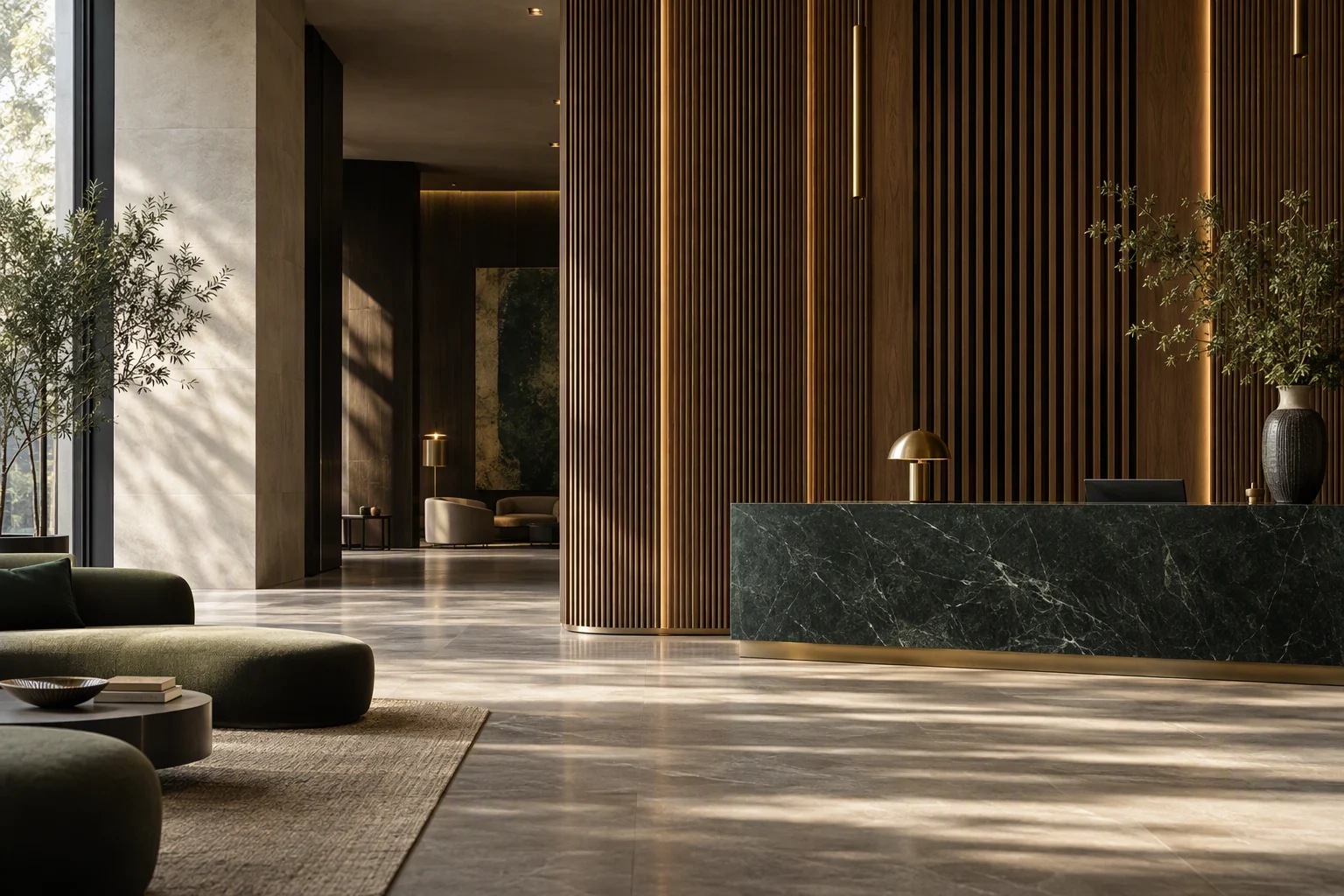
Slat systems hold their rhythm across a large room because the gaps are real voids between battens. Fluted panels read as a carved surface: strong at close range and in raking light, softer from far away. Hotel lobbies and double-height walls usually favour the deeper rhythm; reception desks, wardrobe fronts and joinery-scale surfaces often suit the tighter fluted face.
How does each behave at joints and corners?
A fluted panel is cut and jointed like a flat panel, which keeps the layout simple but demands a profile that matches the machined relief at exposed edges. A slat system needs a deliberate termination: a return, an end cap or a reveal, because battens cannot simply stop mid-wall. Mark these on the drawing before pricing — corner details are where the two systems diverge most in cost.
Can both appear in one project?
Yes, and it is a common specification. Because both lines share the face-layer system, a project can use slat panels on the feature wall and fluted panels on the joinery in one matched tone, without two suppliers and two approval rounds. Each still keeps its own substrate and fixing configuration.
What should a buyer send with the enquiry?
Send the elevation, the intended viewing distance, the wall height, the corner and opening conditions, the finish reference, the quantity and the destination. That is enough to recommend a format and confirm the profile, substrate and thickness against the actual drawing.
BUYER QUESTIONS
Questions to resolve before ordering
Are fluted panels and slat panels the same product with different names?
No. The construction differs: fluted relief is machined into the panel face, while slat systems bond separate lamellas to a backing. Edge details, cutting behaviour and shadow depth follow from that.
Which one is cheaper?
It depends on the format, substrate, pitch and corner detailing for your drawing. Ask for both against the same elevation and the same approved finish rather than comparing two catalogue prices.
Can slat panels be supplied with acoustic backing?
Yes, an acoustic backing layer can be fitted behind the lamellas. The composition is agreed for the project and confirmed in documentation — no universal absorption figures are published.
Do both work on fire-retardant substrates?
Both lines can be configured on fire-retardant substrates without changing the approved decor. The declared characteristics are confirmed for the configuration ordered.